EnterpriseLab
EnterpriseLab: A Full-Stack Platform for Developing and Deploying Agents in Enterprises
Unified infrastructure for training privacy-preserving, cost-effective enterprise AI agents
Ankush Agarwal1,*,
Harsh Vishwakarma1,*,
Suraj Nagaje1,*,
Chaitanya Devaguptapu1
1Fujitsu Research India
*Equal contribution
Abstract
Deploying AI agents in enterprise environments requires balancing capability with data sovereignty and cost constraints. While frontier models like GPT-4o demonstrate strong reasoning abilities, their high inference costs ($3-$15 per million tokens) and data privacy concerns hinder enterprise adoption.
We introduce EnterpriseLab, a full-stack platform that unifies tool integration, data generation, and model training into a closed-loop framework. The platform enables enterprises to train small 8B-parameter models that match GPT-4o’s performance while reducing inference costs by 8-10×.
🎯 Key Contributions
- ✓ Unified Platform: Closed-loop integration of tool connectivity, trajectory synthesis, model training, and evaluation
- ✓ EnterpriseArena Benchmark: 15 containerized applications with 140+ tools across IT, HR, sales, and engineering domains
- ✓ Automated Data Synthesis: Constraint-aware tool graph traversal for executable training data generation
- ✓ Cost-Effective Models: 8B models matching GPT-4o performance with 8-10× lower inference costs
- ✓ Cross-Benchmark Performance: +10% improvement on EnterpriseBench and CRMArena
Key Results at a Glance
Interactive Demos
Watch EnterpriseLab agents in action performing complex enterprise workflows:
🎥 Task Demonstration Videos
📋 Task Demo 1
Multi-step enterprise workflow demonstration showing agent orchestration across HR, document management, and communication systems.
📋 Task Demo 2
Complex cross-functional workflow demonstrating integration of version control, project management, and notification systems.
These demonstrations showcase EnterpriseLab's ability to handle realistic enterprise scenarios involving multiple tools and stateful decision-making.
Introduction
The Enterprise AI Challenge
Enterprise environments require intelligent automation across complex, cross-departmental workflows spanning HR, IT, sales, and engineering. While frontier language models demonstrate strong capabilities, their deployment faces critical constraints:
- Data Sovereignty: Regulations require on-premises deployment
- High Costs: $3-$15 per million tokens for proprietary APIs
- API Latency: Network delays impact user experience
- Privacy Concerns: Sensitive data cannot be sent to external services
The Infrastructure Gap
Small Language Models (SLMs) in the 8B-32B parameter range offer a promising alternative through on-premises deployment and 10× cost reduction. However, effective specialization is hindered by fragmented development pipelines:
Current Challenges:
- Tool integration, data collection, and model training are disconnected
- Existing benchmarks measure performance but don't build agents
- Data synthesis operates independently of execution environments
- No unified infrastructure for iterative development
The EnterpriseLab Solution
EnterpriseLab addresses these challenges by providing a unified platform that integrates:
- Modular Tool Environment: MCP-based architecture for plug-and-play tool integration
- Automated Trajectory Synthesis: Programmatic training data generation from environment schemas
- Integrated Training Pipeline: SFT, DPO, and online RL with continuous evaluation
The EnterpriseLab Platform
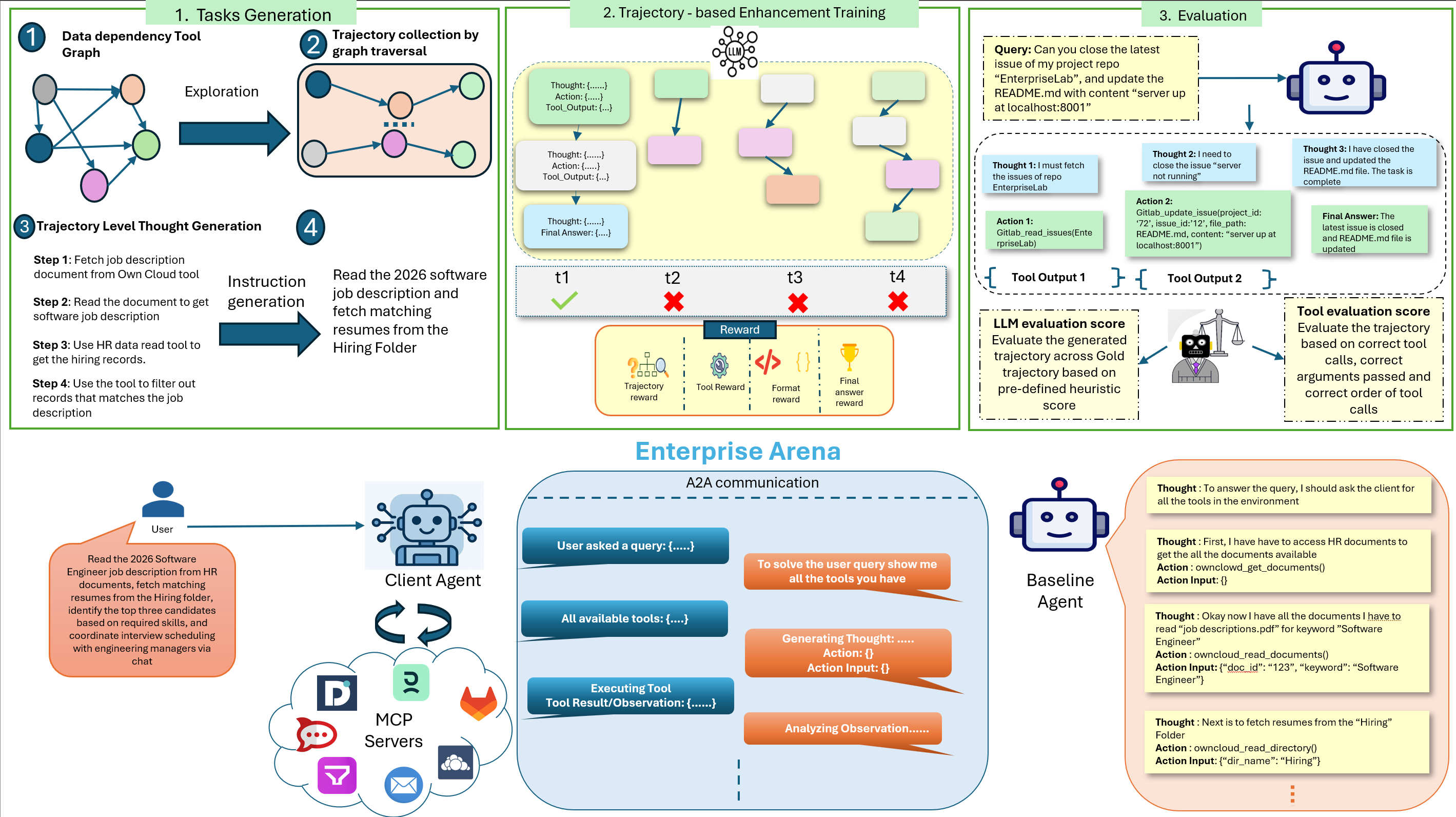
Figure 1: EnterpriseLab's three-module architecture for developing enterprise agents
The platform integrates tool environments, data synthesis, and training infrastructure in a closed-loop system
1. Modular Tool Environment Architecture
The environment layer implements a client-server system built on Model Context Protocol (MCP), featuring:
Dynamic Tool Registry
- Runtime discovery of available tools from active servers
- Unified action schemas with normalized parameter formats
- Semantic conflict resolution (e.g., mapping
repositoryandprojectto standardworkspace_id)
Stateful Execution Containers
- Dedicated Docker instances for each training episode
- Persistent storage across multi-turn trajectories
- Maintained authentication and database states
Observation Normalizer
- Captures heterogeneous tool outputs (APIs, CLI, logs)
- Transforms to token-budget JSON format
- Importance-based truncation prioritizing errors and return values
2. Task Synthesis Pipeline
Automated generation of high-quality, executable training data through four phases:
Phase 1: Tool Graph Construction
Build dependency graph where edges represent data-flow compatibility between tools. Graph ensures any path corresponds to executable sequences.
Phase 2: Constraint-Aware Trajectory Sampling
- Depth-first traversal from valid entry nodes (CREATE, LIST/SEARCH tools)
- Local and global memory buffers for argument satisfaction
- Collects K valid trajectories per starting node
Phase 3: Hierarchical Task Synthesis
- Generate low-level thoughts for consecutive tool pairs
- Compose into high-level user intents
- Example: ‘create repo → add file’ becomes “Set up a new project”
Phase 4: Validation and Filtering
- De-duplication via exact and fuzzy matching (≥0.9 threshold)
- Diversity-based filtering using Maximal Marginal Relevance
- Grounding validation through environment execution
3. Integrated Training Infrastructure
Agent Scaffolding
Support for multiple execution strategies:
- ReAct: Interleaved reasoning and tool execution for open-weight and proprietary models
- Function Calling: Native API-based structured tool schemas for proprietary models
- All executions logged and cached for training
Offline Training Methods
- Supervised Fine-Tuning (SFT): Cross-entropy loss on expert trajectories with LoRA support
- Direct Preference Optimization (DPO): Preference-based alignment from trajectory pairs
Agentic GRPO: Online Reinforcement Learning
Group Relative Policy Optimization adapted for agentic settings:
- Trajectories generated via ReAct-style rollouts
- Trajectory-level rewards from environment execution
- Group-relative advantages for stable credit assignment
- Tool output tokens masked during loss computation
Trajectory Reward Design
Composite reward combining four execution-grounded signals:
- r₁: Tool selection accuracy
- r₂: Execution success (no runtime errors)
- r₃: Final answer correctness
- r₄: Format compliance (ReAct structure)
Overall reward: r(τ) = Σ wₖrₖ(τ), normalized to [0,1]
EnterpriseArena: Benchmark Instantiation
EnterpriseArena demonstrates EnterpriseLab’s capabilities through a comprehensive benchmark environment with 15 specialized MCP servers and 500 expert-curated tasks.
MCP Server Ecosystem
Communication
RocketChat, Mail System
20 tools for messaging and email
Development
GitLab MCP
22 tools for version control and CI/CD
Operations & IT
Zammad, Plane (Jira)
24 tools for ticketing and project management
Human Resources
Frappe HR, Calendar
20 tools for employee management
Data & Storage
Mongoose MCP, OwnCloud
15 tools for database and file operations
Business (CRM)
Dolibarr, Salesforce
19 tools for customer relationship management
Finance
Invoice System
7 tools for invoicing and payments
Utilities
File System, Bash, Browser
18 tools for system operations
Task Complexity and Categories
The 500 expert-curated tasks span five workflow categories with realistic cross-departmental orchestration:
| Task Category | Description | % of Tasks |
|---|---|---|
| CRUD Operations | Create, Read, Update, Delete tasks across systems | 35% |
| Search & Orchestration | Multi-system information retrieval and coordination | 28% |
| Multi-entity Workflow | Complex tasks involving multiple data entities | 18% |
| Version Control | Code management and development operations | 12% |
| Cross-functional Integration | Tasks spanning multiple departments | 7% |
Example Complex Task
Cross-Functional Recruitment Workflow
Task: "Read the 2026 Software Engineer job description, fetch relevant resumes, identify the top three candidates based on required skills, and coordinate interview scheduling with engineering managers via email."
Required Orchestration:
- OwnCloud: Document retrieval
- Frappe HR: Resume database access
- Custom Logic: Skills-based candidate ranking
- Mail System: Coordinated email communication
Complexity: 6-8 tool invocations across 3 systems with stateful reasoning
Stateful Environment Dependencies
Unlike static benchmarks, EnterpriseArena maintains a unified backend where data changes propagate automatically:
- Creating HR employee records updates central registry
- Updates enable subsequent CRM assignments
- Notification dispatches occur without external intervention
- API-level validation enforces enterprise constraints
Expert Validation
Tasks developed through structured reviews with 9 domain experts across Software Engineering, Business Development, Sales, IT Security, HR, and Finance. All tasks rated “Realistic” or above on five-point Likert scale.
Results and Analysis
Performance Across Benchmarks
We evaluate Qwen3-8B models trained with EnterpriseLab across four environments: EnterpriseArena (ours), EnterpriseBench, CRMArena, and τ-Bench.
| Model | EA | EB | CRM | τ-B |
|---|---|---|---|---|
| Closed-Source Models | ||||
| GPT-4o (2-shot) | 0.45 | 0.47 | 0.32 | 0.54 |
| Claude-3.5-Sonnet (2-shot) | 0.60 | 0.55 | 0.34 | 0.56 |
| Gemini-2.5-Pro (2-shot) | 0.71 | 0.55 | 0.49 | 0.59 |
| Open-Source Models | ||||
| Qwen3-8B Base (2-shot) | 0.31 | 0.35 | 0.25 | 0.33 |
| ToolACE (26K-trained) | 0.39 | 0.41 | 0.10 | 0.15 |
| xLAM-2-70B (60K-trained) | 0.15 | 0.40 | 0.12 | 0.17 |
| Our Platform-Trained Models (<1K examples) | ||||
| Qwen3-8B SFT | 0.35 | 0.38 | 0.30 | 0.36 |
| Qwen3-8B Agentic GRPO | 0.43 | 0.51 | 0.35 | 0.42 |
Key Performance Insights
Tool Selection Accuracy
For benchmarks with tool-level annotations (EnterpriseArena and EnterpriseBench):
| Model | EA | EB |
|---|---|---|
| GPT-4o (2-shot) | 0.31 | 0.21 |
| Qwen3-8B Base (2-shot) | 0.14 | 0.14 |
| Qwen3-8B Agentic GRPO | 0.28 | 0.21 |
Cost Efficiency Analysis
| Model | Input ($/1M tokens) | Output ($/1M tokens) |
|---|---|---|
| GPT-4o | $5.00 | $15.00 |
| Claude-3.5-Sonnet | $3.00 | $15.00 |
| Gemini-2.5-Pro | $1.25 | $10.00 |
| Qwen3-8B Agentic GRPO (Self-hosted) | $0.50–$1.00 (combined) |
Result: 8-10× cost reduction while achieving competitive performance makes EnterpriseLab-trained models ideal for cost-sensitive, large-scale deployments.
Impact of Trajectory-Level Optimization
Comparing optimization strategies on EnterpriseBench:
- Agentic GRPO: ~10% improvement over token-level GRPO
- Agentic GRPO vs. DPO: ~15% improvement in execution accuracy
- Tool Selection: ~10% improvement over both baselines
Trajectory-level optimization is critical for multi-turn agentic tasks, validating EnterpriseLab’s design for complete trajectory collection and training.
Synthetic Data Quality Analysis
Analysis of 1,500 synthetic trajectories for EnterpriseBench:
Diversity
- Self-BLEU score: 0.4 (moderate diversity)
- 70 unique APIs across 5 enterprise domains
- Balanced distribution: Software Engineering (34.4%), CRM (25.3%), HR (20.8%), Operations (16.0%), IT (3.5%)
Complexity
- Average 3.2 turns per dialog (σ = 1.29)
- 68.1% require multi-turn reasoning
- 54.7% involve multi-tool composition with dependency chains
Correctness
- Rule-based validation: 100% pass rate (schema compliance)
- GPT-4 semantic evaluation: 81.9% pass rate (200-sample stratified)
Adaptation to Environment Changes
Testing robustness with 30% tool modifications (schemas, parameters, data) on EnterpriseBench:
| Scenario | LLM Eval | Tool Eval |
|---|---|---|
| Original environment | 0.50 | 0.20 |
| Modified environment (30% changes) | 0.43 (-15%) | 0.15 |
| + 200 incremental training samples | 0.48 (95% recovery) | 0.18 |
Insight: EnterpriseLab supports rapid model adaptation to evolving environments with minimal additional data, without full retraining.
Training Efficiency
Time to Production
- SFT/DPO: 30 minutes to 2 hours on 2×A100 GPUs
- Agentic GRPO: 24-30 hours on 4×H200 GPUs
- Total: Production-ready models from raw tool schemas in under 2 days
Error Analysis
Analysis of 50 failure cases reveals systematic patterns:
| Failure Mode | Frequency | Description |
|---|---|---|
| Tool Parameter Errors | 42% | Incorrect arguments causing API failures; limited error recovery |
| Domain Misselection | 28% | Ambiguous cues lead to wrong tool selection and recursion loops |
| Task Decomposition | 18% | Completing initial sub-task but failing to plan subsequent steps |
| Context Loss | 12% | Loss of coherence in longer interactions |
Comparison with Existing Benchmarks
EnterpriseLab and EnterpriseArena uniquely address multi-application enterprise orchestration with dynamic data:
| Benchmark | Domain Focus | Multi-App Flow | Dynamic Data | Training Platform |
|---|---|---|---|---|
| AgentBench | General Reasoning | ✗ | ✗ | ✗ |
| WebArena | Web UI | ✗ | ✓ | ✗ |
| SWE-bench | Software Eng. | ✗ | ✗ | ✗ |
| CRMArena | CRM | ✗ | ✗ | ✗ |
| EnterpriseBench | General Enterprise | ✓ | ✗ | ✗ |
| τ-Bench | Customer Service | ✗ | ✓ | ✗ |
| EnterpriseLab + Arena | Cross-Functional Enterprise | ✓ | ✓ | ✓ |
Citation
If you use EnterpriseLab or EnterpriseArena in your research, please cite our work:
@article{enterpriselab2026,
  title = {{EnterpriseLab}: A Full-Stack Platform for Developing and Deploying Agents in Enterprises},
  author = {Nagaje, Suraj and Vishwakarma, Harsh and Agarwal, Ankush and Devaguptapu, Chaitanya},
  journal = {arXiv preprint arXiv:XXXX.XXXXX},
  year = {2026}
}
🚀 Get Started with EnterpriseLab
EnterpriseLab provides the first unified platform for training privacy-preserving, cost-effective enterprise AI agents. Transform your enterprise tools into specialized agents with:
- Automated training data generation from your tool schemas
- 8-10× cost reduction vs. proprietary APIs
- On-premises deployment for data sovereignty
- Continuous evaluation and adaptation
Visit our GitHub repository to get started!
EnterpriseLab
Full-Stack Platform for Enterprise AI Agents
Contact: suraj.nagaje@fujitsu.com
© 2026 EnterpriseLab. Preliminary work under review.